A craft of cut clay and long memory.
Where zellige comes from, the buildings that define it, and the workshops that keep it alive.
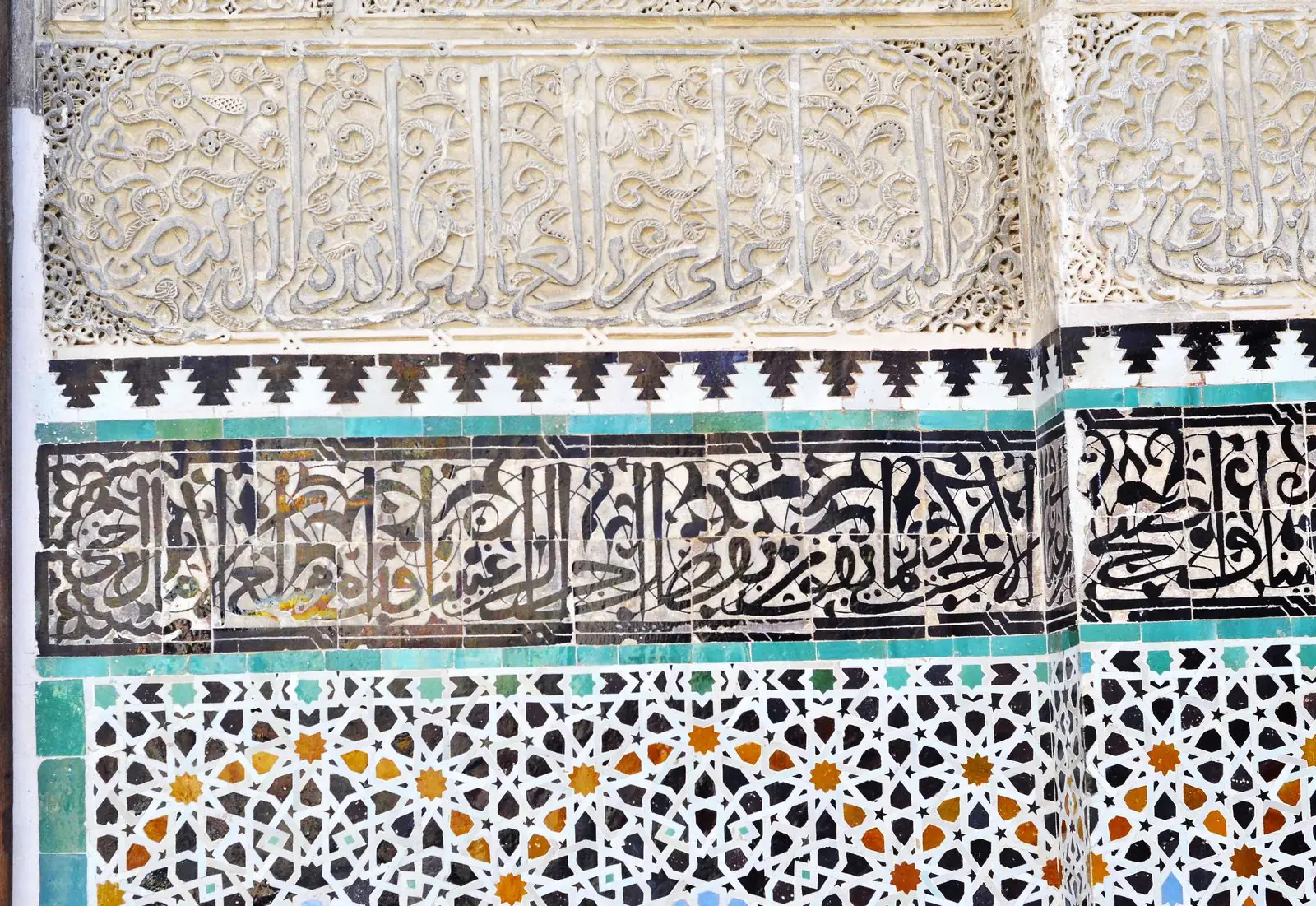
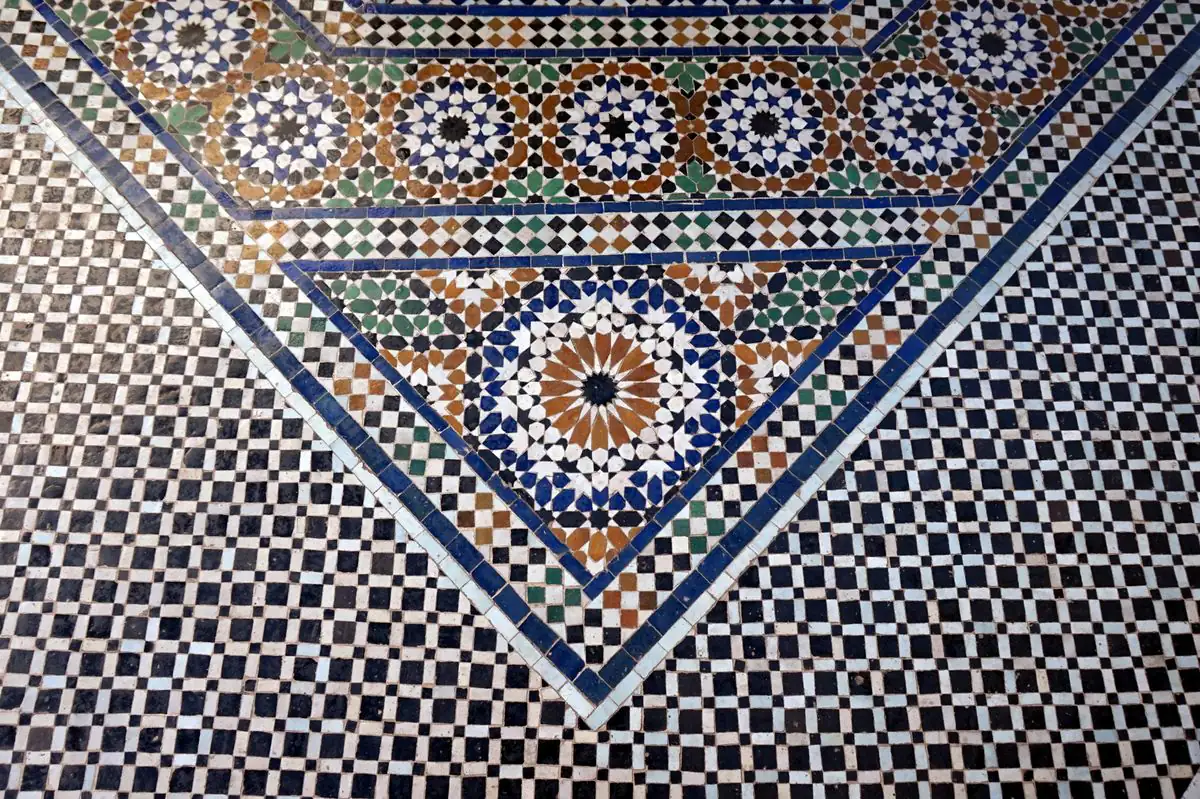
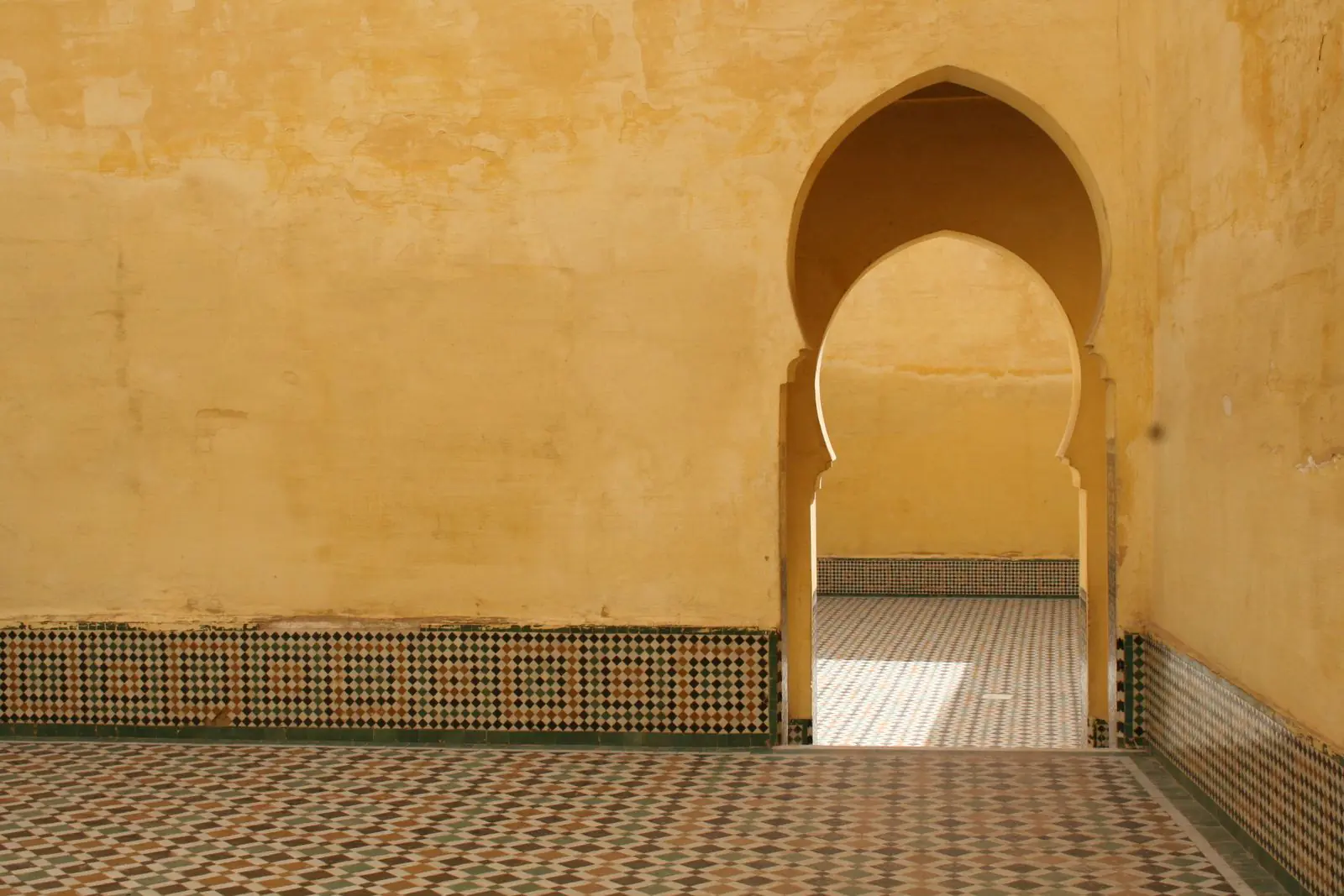
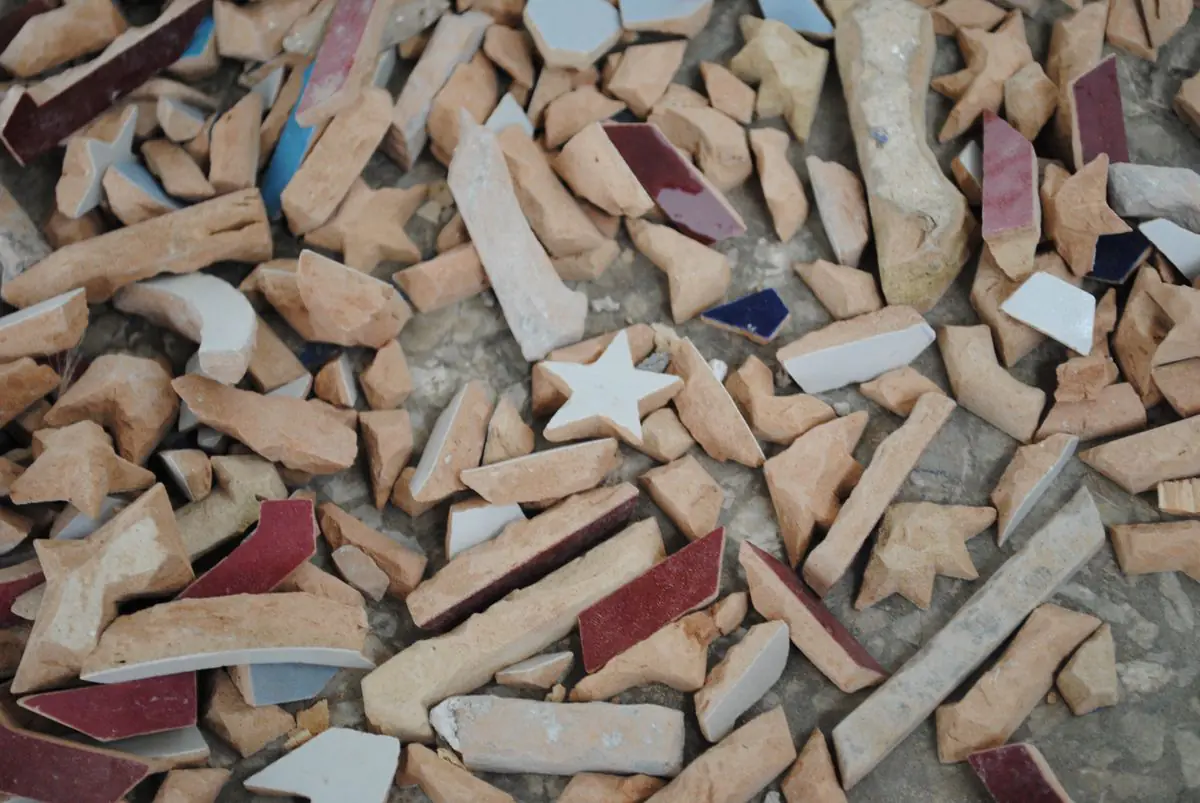
Zellige, often written zillij in English scholarship, is a mosaic of individually cut pieces of glazed earthenware. A glazed tile is fired, then shaped piece by piece with a sharp hammer, and the pieces are fitted together into a geometric field. A Marinid frieze in the Batha Museum in Fez records the same principle in the fourteenth century: black-glazed tile cut away with a hammer to reveal the fired clay beneath.179
Its first appearance in Morocco is not settled. A 2001 AramcoWorld feature associates the technique with the Almoravid and Almohad imperial cities, while the objects we could check date from the fourteenth century: the Victoria and Albert Museum holds a fragment of cut-tile mosaic (alicatado, the Spanish term) from the Alhambra dated about 1300–1400, and the Metropolitan Museum holds glazed and carved tiles from fourteenth-century Morocco. Because the sources we consulted give no single agreed date of origin, this guide dates only specific buildings and objects.17131415
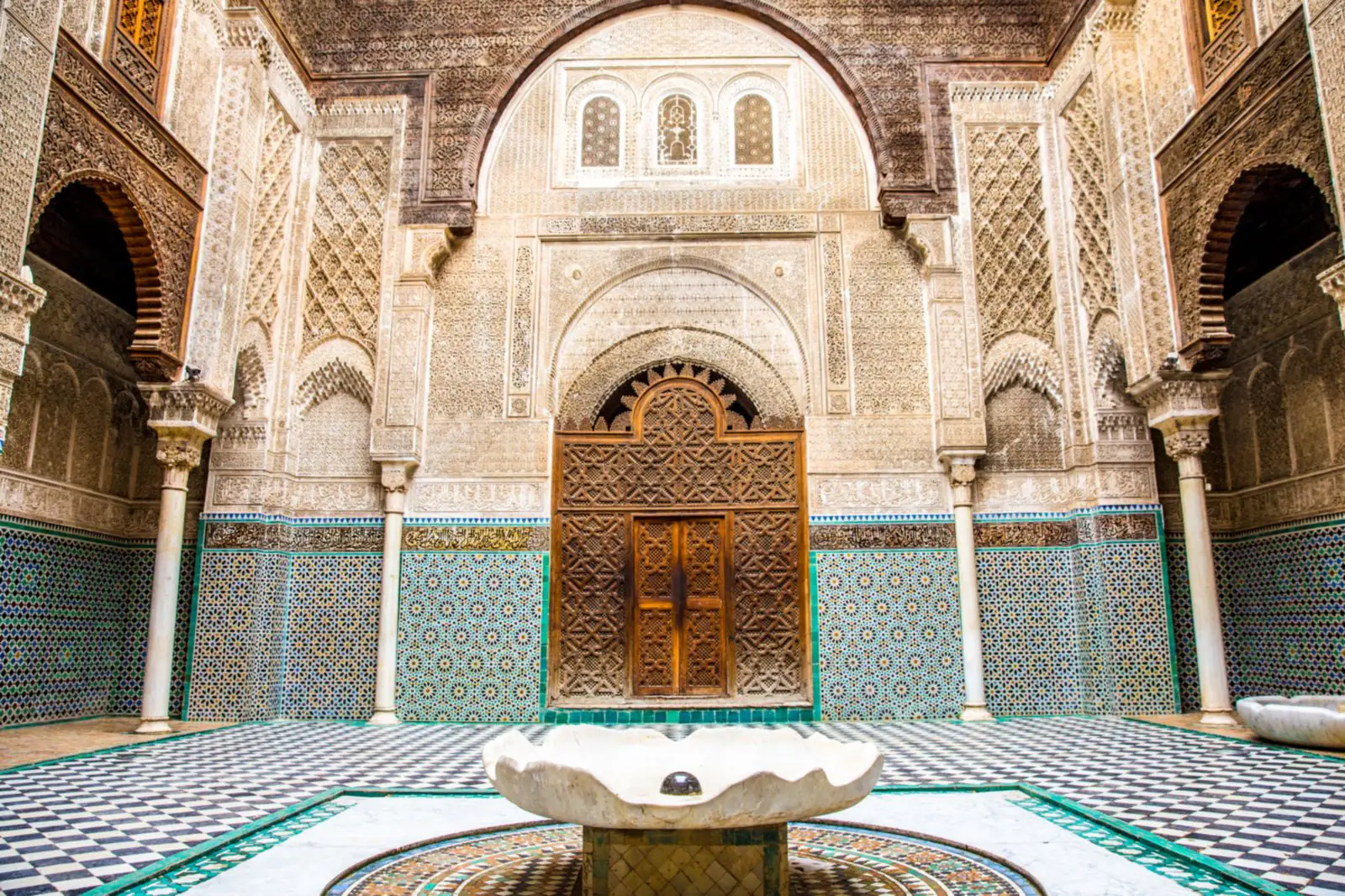
Fez is the center of the story. UNESCO dates the medina to the ninth century and places its height in the thirteenth and fourteenth centuries under the Marinids, when Fez replaced Marrakesh as capital; most of its principal monuments, the madrasas among them, date from that period. The Madrasa al-‘Attarin, built in 1323–1325 for the sultan Abu Sa‘id ‘Uthman II, has a courtyard dressed in glazed tile dados and paving, which Archnet’s description compares with the Nasrid Alhambra.156
At the Madrasa al-Bu‘inaniya, built for the sultan Abu ‘Inan in the 1350s, Archnet describes glazed tile dados set with carved wood and carved stucco across the courtyard façades, a religious translation of Nasrid palace materials. The Batha Museum’s frieze, salvaged during twentieth-century restoration of this madrasa, is dated 1351–1356.79
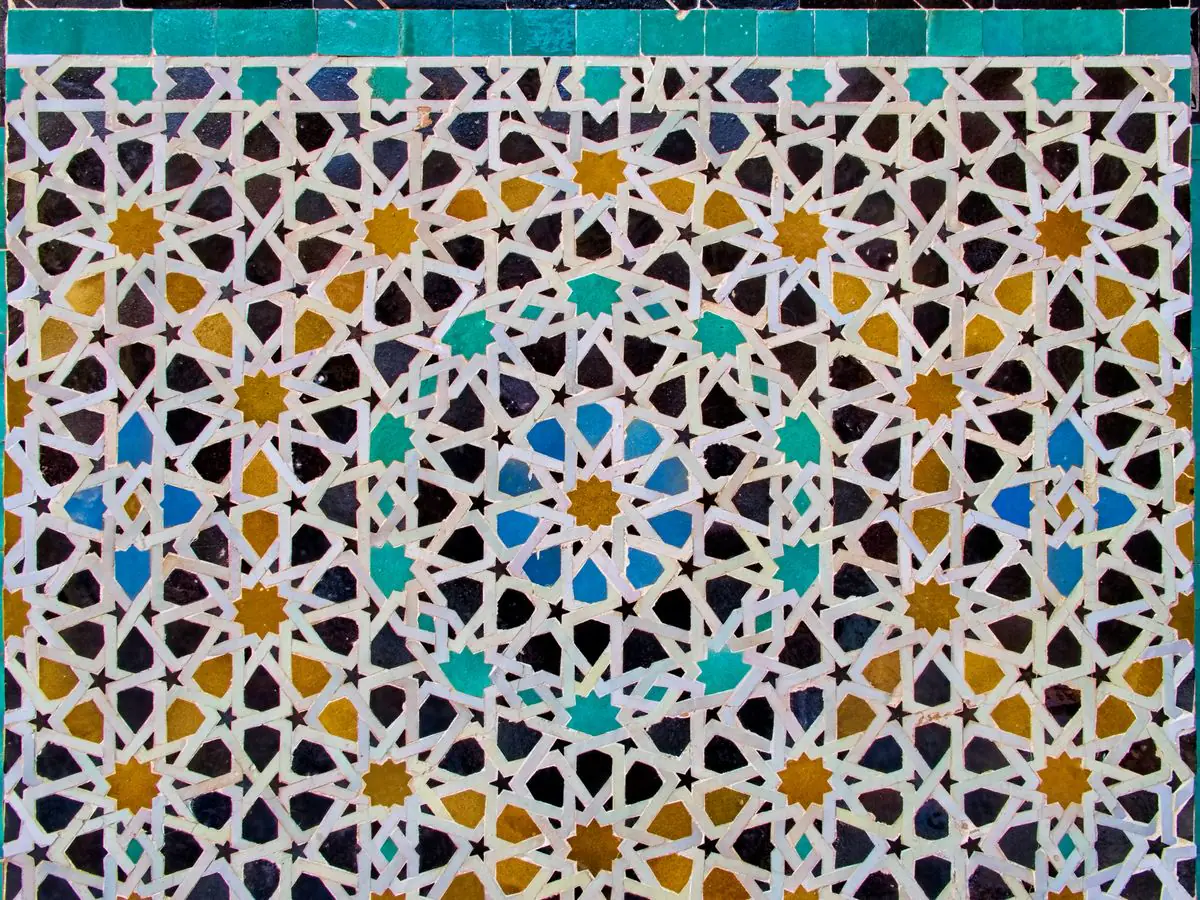
Across the strait, the Nasrid palaces of Granada are the Andalusian context. The Alhambra and Generalife were inscribed by UNESCO in 1984, with the Albayzín added in 1994. The Patronato de la Alhambra documents panels whose vocabulary is close to the Moroccan one: eight-point stars and cross-shaped pieces held in interlacing ribbons, and a palette of white, honey, black, blue and green.41012
The same AramcoWorld account reports that the expulsion of Muslims from Spain in 1492 brought new craftsmen and patrons to Fez. We cite it as reportage rather than as a scholarly finding.17
Later dynasties carried the language forward. UNESCO names the Saadian Tombs among the monuments of the Medina of Marrakesh, and Archnet dates their expansion under Ahmad al-Mansur to 1591–1603; the records we consulted describe the architecture rather than its tile program, so we attribute no particular pattern to them. Meknes became a capital under Moulay Ismaïl (1672–1727), who built it, in UNESCO’s words, in a Spanish-Moorish style.283
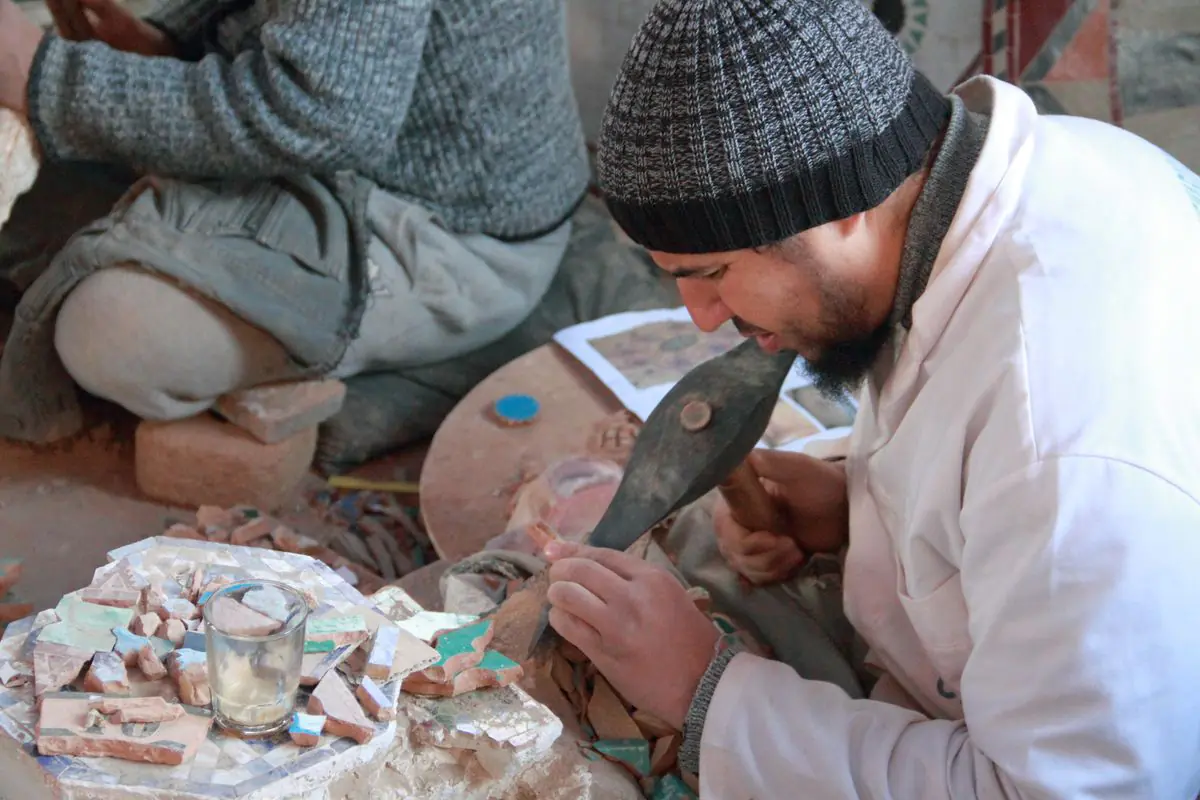
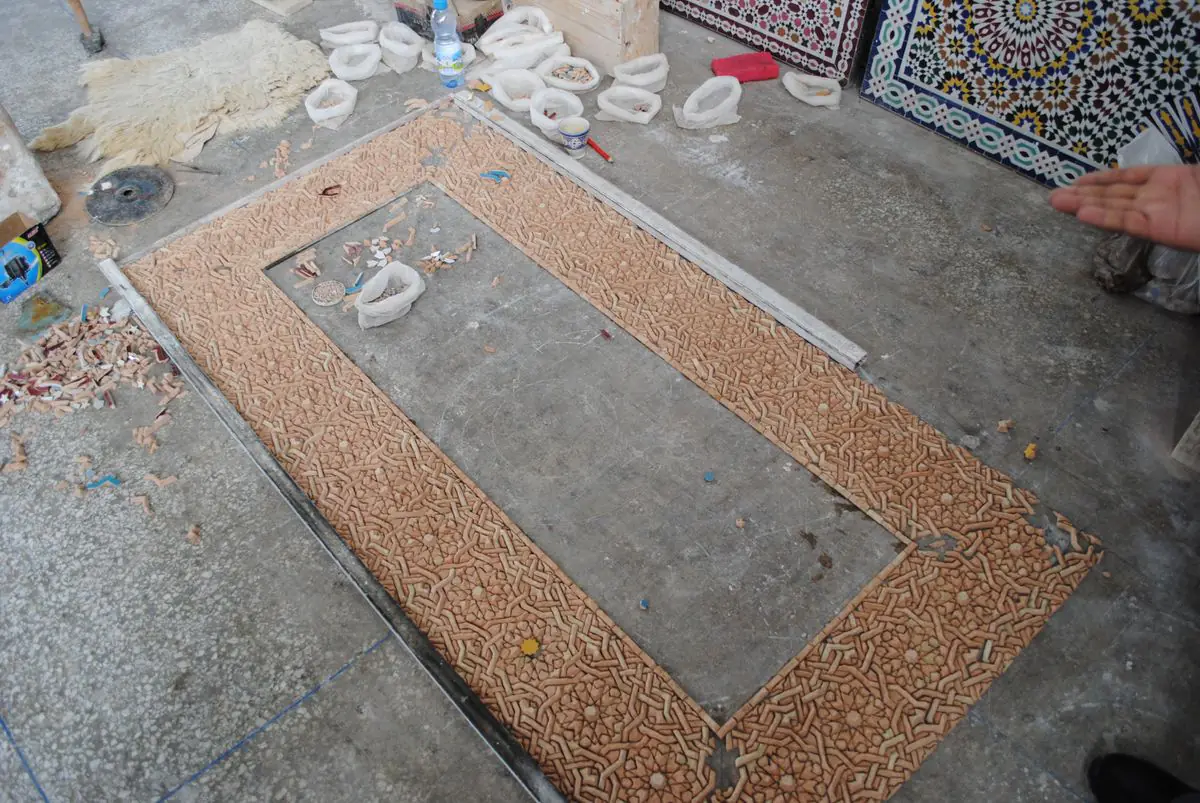
The craft is still practiced in Fez. Workshops fire tiles from local clay, glaze one face, and divide the work between cutters, who shape each piece, and layout artists, who assemble the panel face down from a drawing before it is backed. AramcoWorld describes a royal revival of commissions from 1961 to 1999. In 2011 craftsmen from Fez built the Moroccan Court at the Metropolitan Museum on site, in cut and glazed tilework.1716
Two books are standard references for deeper study: André Paccard’s two-volume survey of Moroccan architectural crafts (1980) and John Hedgecoe and Salma Samar Damluji’s study of Moroccan ceramics (1992). We list their catalog records; their plates were not reviewed for this guide.1920
Pieces, stars and the repeat.
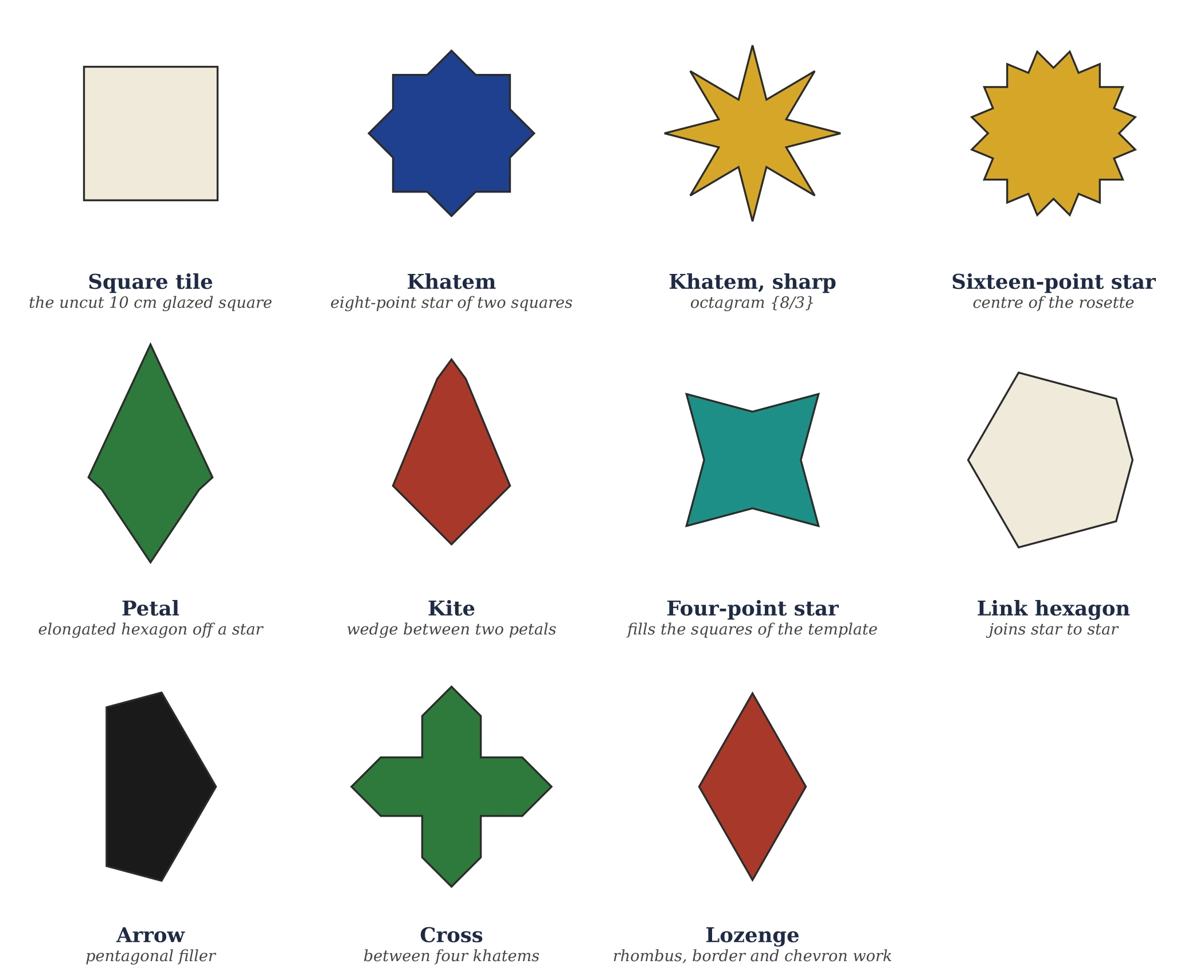
A composition is assembled from a vocabulary of cut shapes. The star sets the rhythm; the smaller pieces make it fit.
Each cut piece is a furmah. AramcoWorld reports that one scholar counted some 360 types, from star medallions to chevrons, triangles, hexagons and lozenges, and that some take their names from everyday objects. A cutter traces the outline from a template, scores it with a chisel-edged hammer and strikes the piece free, then trims it.17
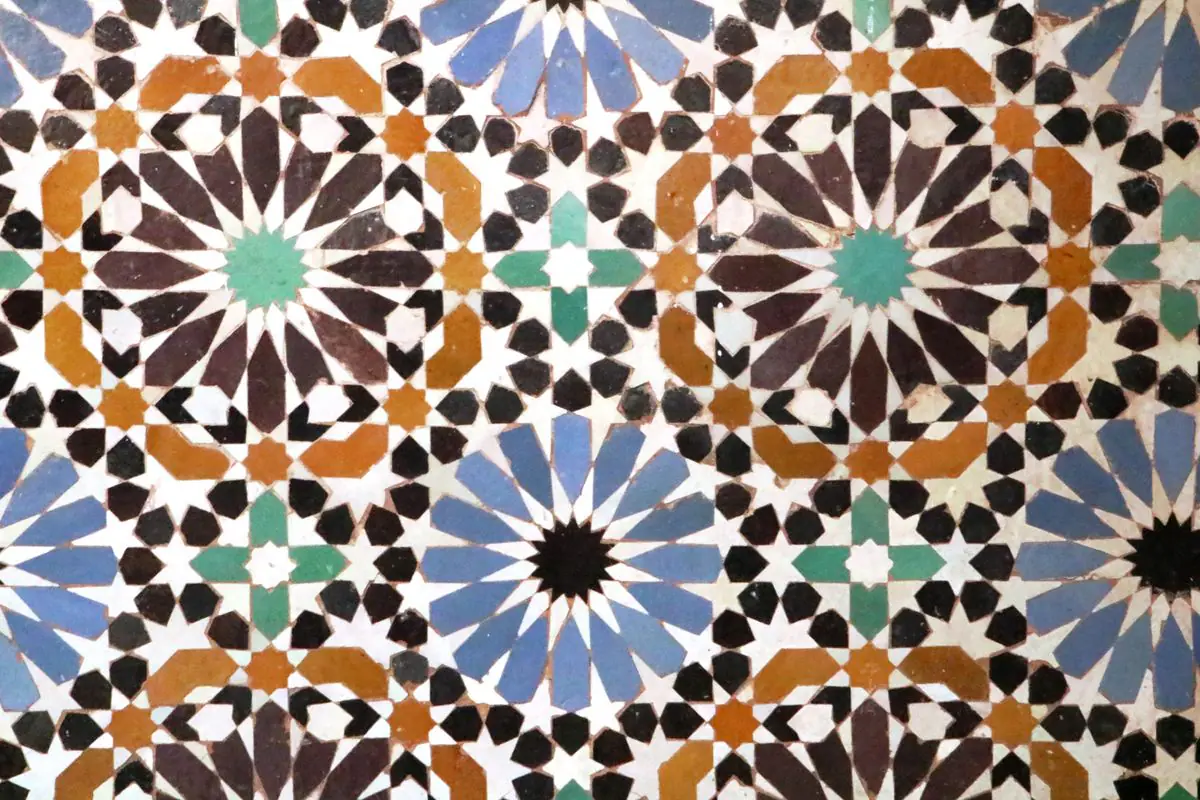
Stars are named by their number of points. The same account gives ‘ishrini for a twenty-point star and arba‘ wa ‘ishrini for twenty-four, and notes that the names of the largest stars are rounded: a so-called fifty-point star has forty-eight points.17
The eight-point star is the foundation of much of this geometry. In his study of an Alhambra dado, Manuel Martínez Vela draws it as two squares superimposed at 45 degrees, derives every piece of the panel from it, and extends the finished module across the wall by reflection and translation.11
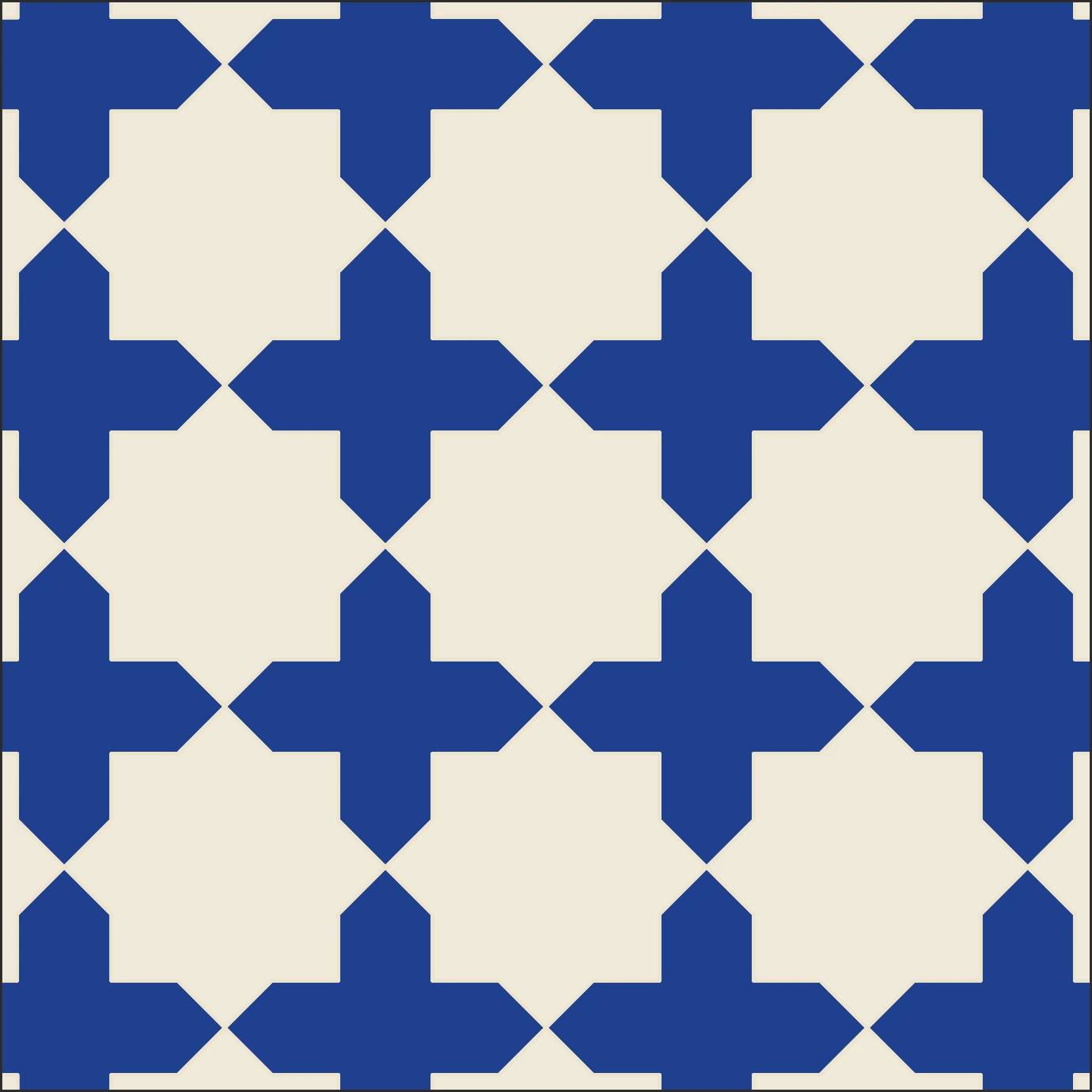
The star-and-cross is the clearest case of two shapes completing one another. In the Generalife panel the white pieces come in just two forms, eight-point stars and crosses, each interlocking with its neighbors inside a net of colored ribbons.10
A useful way to read any field is to find its smallest repeating unit: the block that, copied side by side, rebuilds the whole surface without gaps. Point counts describe a star, not the symmetry of the whole field, and a single composition can combine stars of different orders. Computational studies treat zellij in the same spirit, as patches of cut shapes fitted into a larger arrangement.18
The atelier’s star and cross is an independently drawn arrangement in this family, not a copy of a historic panel. In the illustration, the dashed square marks one repeat of our digital field.
The field and its frame.
A field repeats in every direction. A border runs in one, and tells the eye where the surface ends.
Historic panels separate a repeating field from a framing frieze. In the Alhambra dado studied by Martínez Vela, a field of interlocking T-shaped pieces sits beside a border of honey-colored eight-point stars alternating with elongated hexagons on a green ground; field and border are drawn from the same star. In the Generalife panel, a crenellated frieze is divided from the field below by a horizontal band of black tiles.1110
The difference is directional. A field can be extended across a wall of any size; a border is a row, its stars sharing points along a single line, so it must turn or stop where the surface does. Designing the two together, from shared geometry and glazes, is what makes a border read as part of the surface rather than a trim applied afterwards.11
In the atelier studio, the border is an outside frame drawn within your surface: the bands are measured inward from the edge and the field fills what remains. The field is never cut through by a band, so the last repeat you see is complete.
Charafa: the crown where tile meets plaster.
A stepped frieze along the top of a tiled dado, recalling the merlons of a fortified wall.
The Batha Museum’s Marinid frieze from the Bu‘inaniya Madrasa sat, according to its museum record, below “a frieze of geometric motifs known as charafa”, which the record likens to crenellations. That frieze made the transition from the glazed earthenware below to the carved plaster paneling on the walls above.9
The Generalife panel in Granada shows the same idea: an upper frieze of crenellations, white merlons rising and black ones descending, separated from the field by a horizontal band of black tiles. The Patronato describes it in Spanish as almenas, crenellations.10
A note on the name: “charafa” is attested in the Museum With No Frontiers record above, in English transliteration. We did not find it used consistently across the other reliable sources we consulted, which describe the same kind of frieze as crenellations or almenas, and we have not verified an Arabic spelling or derivation. Read Charafa here as the atelier’s name for a crenellated frieze, grounded in that one record.910
The atelier’s Charafa is a stepped crown of interlocking merlons in two alternating glazes, with fitted background cuts between them. Following the documented upper position, it runs along the top edge only, never as a four-sided frame. Its proportions are our own drawing, not a copy of either panel.
Fillets and edge bands.
A narrow, continuous band that separates, steadies and finishes.
Narrow bands do structural work in historic panels. In the Generalife, a single horizontal row of black tiles divides the crenellated frieze from the field. In the Sala de la Barca at the Alhambra, white bands form octagons around eight-point stars, so the line is woven through the field itself.1012
“Fillet” is an English architectural word for a narrow flat band, used here for convenience. A fillet reads as a drawn line: it divides two zones, gives a figured band a clean edge, and steadies the perimeter, where small variations in hand-cut pieces are most visible. A contrasting glaze makes it graphic; a near tone makes it disappear into the field.
The atelier’s Glazed fillet is a continuous run of cut tile with a square piece at each corner. Our presets use a single 1.2 cm fillet, or a pair of 0.7 cm and 1.2 cm in contrasting glazes. These widths are digital design intent; the maker has not yet confirmed them.
Layering bands.
Historic walls build up in horizontal registers. A layered border borrows that order.
The Batha Museum record gives a complete vertical sequence for one Marinid wall: the ceramic paneling of the dado, then a cut-tile band carrying an inscription in a braided frame, then the charafa frieze, and above it carved plaster.9
Archnet’s descriptions of the Fez madrasas show the same layered logic at the scale of a courtyard: glazed tile dados at the base, carved stucco above, carved and painted wood higher still.76
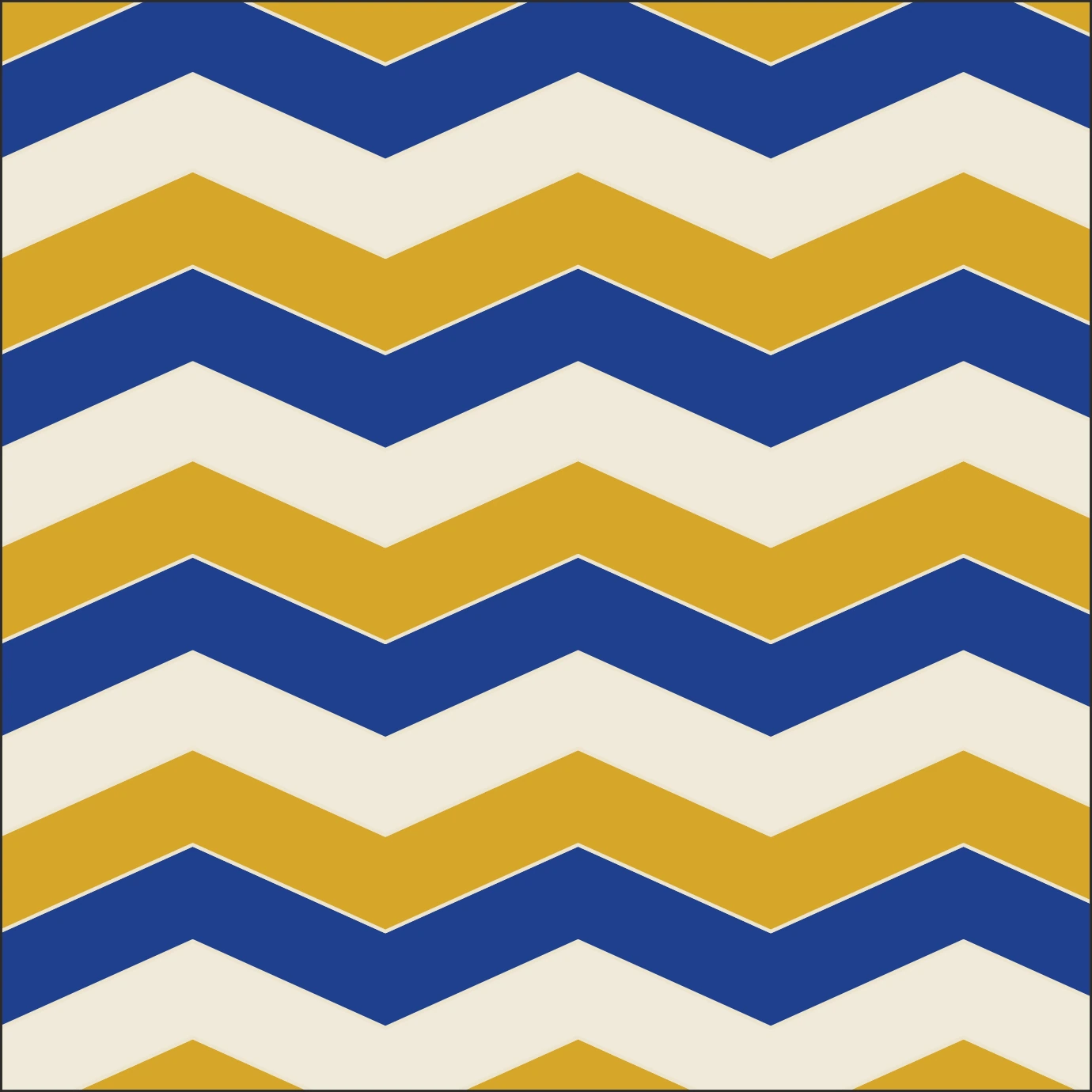
From that order we take a working principle rather than a rule: alternate figured bands with plain ones, let a fine line separate two patterns, and keep the crown, if there is one, outermost at the top. The sources describe particular walls; they do not prescribe a fixed sequence.
The atelier studio holds up to three bands, listed from the outside in. Our Layered Charafa preset sets a 3 cm Charafa crown, a 0.6 cm fillet and a 2 cm lozenge band; each band sits inside the one before, and the field takes the space that remains. All three widths await the maker’s confirmation.
Corner solutions.
Where two runs of a border meet, the pattern must either fold or pause.
The sources we consulted describe fields and friezes but set out no general rules for turning a border at a corner. This section is a design explanation, not a historical claim.
A mitered corner continues the pattern round the turn on a 45-degree line. It is seamless, but it asks a lot: the band must be symmetrical across its width, both runs must arrive at the same point in their repeat, and the pieces on the diagonal become special cuts. A corner block places a square piece, or a small medallion, where the runs meet. Each run then stops square against it, which absorbs small differences in length and lets the corner carry an accent glaze.
The atelier’s fillets and lozenge frames use corner blocks: four square cuts in the accent glaze. The Charafa needs no corner because it crowns the top edge only. When your design is confirmed, the maker may propose a different corner for your dimensions.
Scale, joints and the hand-cut edge.
How big a repeat should be, and why a zellige joint is so narrow.
In the Fez workshops AramcoWorld describes, pieces are cut from square “mother tiles” about 10 cm a side. The finishing cutter bevels the back of each piece so that only the glazed edges meet, which allows the pieces to sit very close together.17
Within one composition, pieces vary greatly in size. The same account describes a single twenty-four-point star panel needing about 5,000 pieces in 32 shapes and eight colors.17
Because every piece is struck and trimmed by hand, no two edges are identical, and the glaze pools and thins across each face. Set tight, these small irregularities become the texture of the surface; a wide, uniform grout line would turn them into a grid.
The atelier offers three digital formats: 2.5, 5 and 10 cm. For a square field this is the edge of each tile; for stars and other compositions it is a nominal repeat module, not the size of every piece. These are planning formats for this atelier, not historical standards.
Our previews draw a fine, tight joint in the grout tone you choose. It is a simulation: the real joint depends on the cut and on your setter. For laying, we recommend a fine or unsanded grout, as described on our installation page.
Design, then the maker’s confirmation.
Every design on this site is a preview. A workshop decides what can be cut and built.
In the traditional workflow the drawing travels to the workshop: cutters shape the pieces it calls for, and the layout artist assembles them face down, from the center outward, until the panel is complete.17
Before anything is produced, the workshop confirms four things: that each cut shape can be cut and fitted; the width of every band; the glazes, judged against physical samples; and that the design can be built at your dimensions, including how the repeat, the corners and the edges resolve.
Band widths shown in the studio have not yet been confirmed by the maker. Treat them, and our glaze names, which describe on-screen colors, as design intent until the workshop has reviewed your brief.
- Cut shapesEach piece can be cut and fitted.
- Band widthsEvery band, measured for your design.
- GlazesJudged against physical samples.
- BuildabilityRepeat, corners and edges resolved at your dimensions.
Put the geometry to work.
Compose a field and its border in the studio, then see the glazes in your own light.
Sources
All sources accessed 18 October 2026. Catalog records for books are listed for further reading; their contents were not reviewed for this guide. Photographs are credited beside each image; plates come from the library’s illustrated guide.
- Medina of Fez (opens in a new tab)Inscribed 1981. Founding in the ninth century; the Marinid height in the thirteenth and fourteenth centuries.
- Medina of Marrakesh (opens in a new tab)Inscribed 1985. Almoravid foundation in 1070–72; names the Saadian Tombs among the city’s monuments.
- Historic City of Meknes (opens in a new tab)Capital under Moulay Ismaïl (1672–1727), described by UNESCO in Spanish-Moorish style.
- Alhambra, Generalife and Albayzín, Granada (opens in a new tab)Inscribed 1984, extended to the Albayzín in 1994. Nasrid palatine city.
- Madrasa al-‘Attarin, Fez (opens in a new tab)Commissioned by the Marinid sultan Abu Sa‘id ‘Uthman II; built 1323–1325.
- Madrasa of al-‘Attarin (opens in a new tab)Glazed tile dados and pavement; the revetment evokes the Nasrid Alhambra.
- Madrasa al-Bu‘inaniya, Fez (opens in a new tab)Glazed tile dadoes, carved wood and carved stucco on the courtyard façades.
- Saadian Tombs, Marrakesh (opens in a new tab)Mid-sixteenth-century foundation, expanded under Ahmad al-Mansur, 1591–1603.
- Excised zellij frieze, Batha Museum, Fez (inventory C18) (opens in a new tab)From the Bu‘inaniya Madrasa, AH 751–7 / AD 1351–6. Names the charafa frieze above the band.
- Panel de alicatado del Generalife (opens in a new tab)Upper crenellated frieze above a field of interlace, eight-point stars and cross-shaped pieces.
- Fragmento de zócalo de alicatado: su diseño y trazado geométrico (opens in a new tab)Fourteenth- to fifteenth-century dado fragment; field and border both derived from the eight-point star.
- La Alhambra restaura dos paños de alicatados de la Sala de la Barca (opens in a new tab)White, honey, black, blue and green pieces; white bands forming octagons around eight-point stars.
- Fragment of tile mosaic (alicatado), Alhambra, about 1300–1400 (opens in a new tab)Tin-glazed earthenware.
- Tile, Morocco, 14th century (object 446880) (opens in a new tab)Collection record; glazed tile.
- Panel of Four Calligraphic Tiles, Morocco, 14th–early 15th century (opens in a new tab)Glazed and carved tile.
- The Moroccan Court (Art of the Islamic World, educator resource, image 12) (opens in a new tab)Court built on site in 2011 by craftsmen from Fez using cut, glazed tilework.
- Zillij in Fez (opens in a new tab)Workshop reportage: mother tiles, cutting, furmah, face-down assembly, twentieth-century revival.
- Generative Zellij (opens in a new tab)Describes zellij as a style of geometric pattern found in Morocco and southern Spain.
- Traditional Islamic Craft in Moroccan Architecture (2 volumes, Atelier 74, 1980) (opens in a new tab)Bibliographic record only. The plates were not reviewed for this guide.
- Zillij: The Art of Moroccan Ceramics (Garnet, 1992) (opens in a new tab)Bibliographic record only. The book was not reviewed for this guide.